Will a 400W Solar Panel Run a Fridge in Herriman?
The panel's wattage is only half the math; when your fridge pulls power matters just as much.
Will a 400W solar panel run a fridge?
Yes, on most days a single 400W panel makes enough energy to cover a typical refrigerator's daily use, but it cannot run the fridge by itself. You also need a battery to carry it through the night and cloudy spells, and an inverter sized for the compressor's startup surge. (801) 528-3459
How much energy does a 400W panel actually make?
The 400W rating is what the panel produces under lab test conditions: bright, direct light on a cool cell. On your home, real output is lower because of heat, wiring losses, inverter efficiency and the angle of the sun. A fair planning number is about 75 to 80 percent of the rating during the best hours of the day.
Daily energy depends on peak sun hours, the number of hours that add up to full-strength sunlight. Along the Wasatch Front, long clear summer days give you many more of those hours than short winter days do, and snow on the glass drops output to almost nothing until it slides off.
- Bright summer day: roughly 400W x 5 to 6 sun hours x 0.8, or about 1.6 to 1.9 kWh
- Clear winter day: roughly 400W x 3 sun hours x 0.8, or about 1 kWh
- Overcast or snow-covered: a small fraction of either figure
How much power does a refrigerator use?
A refrigerator does not draw power steadily. The compressor cycles on and off, running somewhere around 100 to 250 watts when it is on and close to zero when it is off. Over a full day, many full-size modern models land near 1 to 2 kWh, while older units and side-by-sides with ice makers often use more.
The most accurate number for your fridge is on its yellow EnergyGuide label, listed as kilowatt-hours per year. Divide that figure by 365 and you have the daily target the panel needs to meet. If the label is gone, a plug-in watt meter left on the outlet from one morning to the next gives you a real reading.
Two details catch people out. The defrost heater kicks on a few times a day and briefly pulls several hundred watts, and the compressor's startup surge can be three to five times its running draw for a second or two.
Why the panel alone is not enough
Your fridge runs all night and the panel makes nothing after sunset. Even at noon, a passing cloud can drop output below what the compressor needs, and a panel wired straight to an appliance has no way to make up the gap. That is why a fridge on solar needs storage and power conversion between the panel and the plug.
A working setup has four parts. Each one exists because of a specific limit in the others.
- Charge controller: regulates the panel's DC voltage so it charges the battery safely
- Battery: stores daytime surplus and covers nights and gray days; lithium iron phosphate handles daily cycling well
- Inverter: converts battery DC to the 120V AC your fridge expects, and must handle the startup surge, not just the running watts
- Margin: a second panel or a larger battery for the short, snowy weeks of December and January
Running a fridge from a whole-home system instead
Most homeowners asking this question are really asking whether solar can keep food cold during an outage or trim the power bill. A grid-tied solar panel installation sized for your home's full usage answers the bill question, because the fridge simply becomes one of many loads the array helps cover. Grid-tied systems shut off during an outage for line worker safety, though, so on their own they will not keep the fridge running when the power is out.
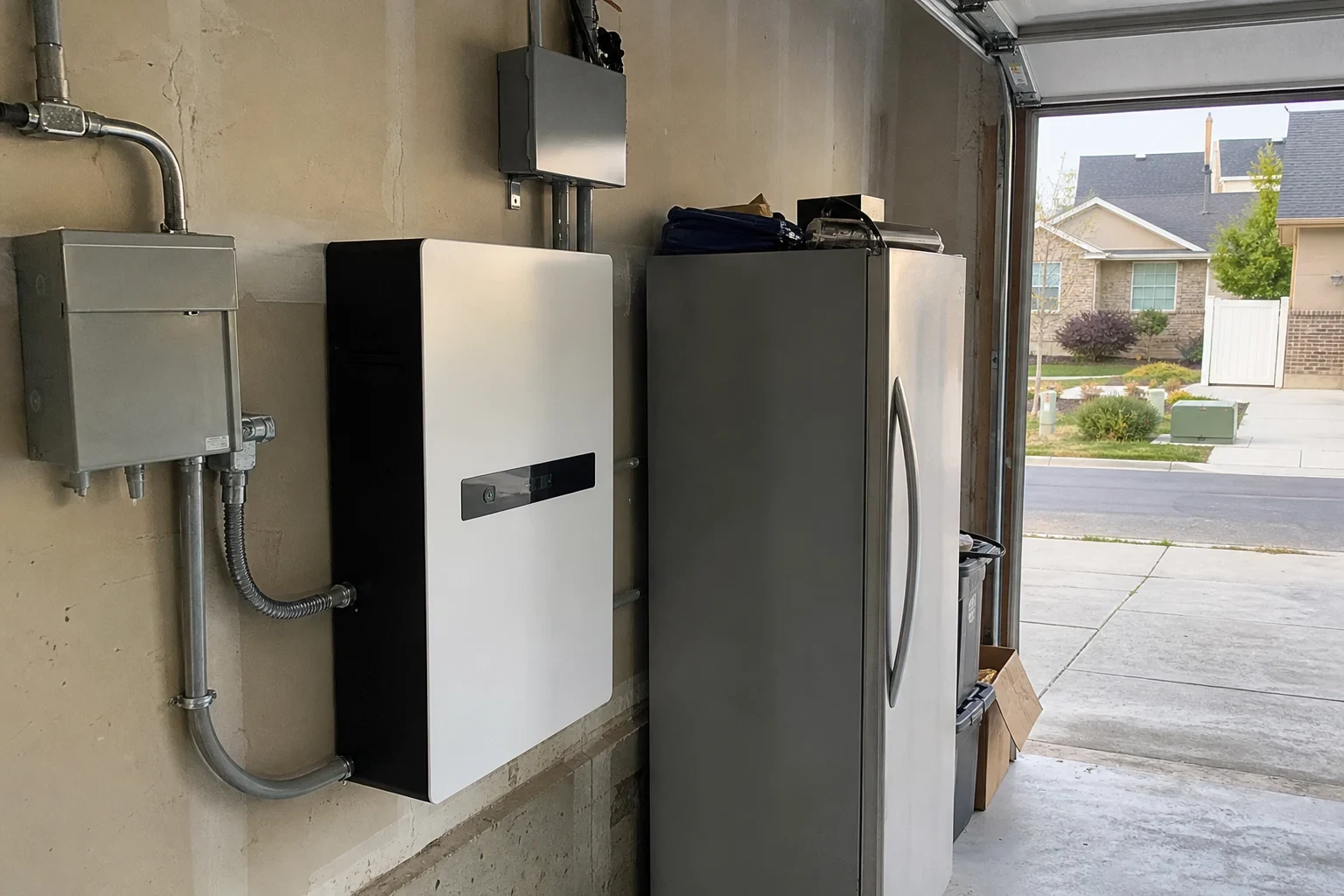
Adding battery storage changes that. A home battery can be set up to back up a critical-loads panel that includes the refrigerator, freezer, furnace blower and a few lights, and the array recharges it the next morning. We size the battery from your actual usage so you know how many hours or days it can carry those circuits.
When we look at a home, we walk you through these numbers the way we would for a neighbor: what the fridge uses, what the array will produce in winter as well as summer, and whether storage is worth it for how you live.
More questions about solar and refrigerators
Something not covered here? (801) 528-3459
Can a 400W panel run a chest freezer?
Often more easily than a fridge. Chest freezers are well insulated and many use less daily energy than an upright refrigerator, but they still need a battery and inverter for nights.
Will a small portable power station handle my fridge?
It can for a while if its inverter covers the compressor surge and its battery holds more than the fridge's daily use. Check both numbers against your EnergyGuide label before relying on one during an outage.
Does cold weather hurt solar output?
Cold actually helps panel efficiency. The winter drop in Herriman comes from shorter days, a lower sun angle and snow cover, not from the temperature.
Is a refrigerator a good reason to add a home battery?
It is one of the most common reasons. Keeping food cold through an outage is a clear, practical use, and the same battery can back up your furnace fan and lights.
Find out what solar can carry for your home
Tell us about your home and your power bills, and we'll work out what an array and battery would produce, what they would cover, and whether your fridge and other key circuits can stay on through an outage.